How to build the right team for a successful pharma product launch

You’ve invested years in developing a new therapy. Now comes arguably the hardest part: bringing it to market. How that launch unfolds can shape the therapy’s commercial performance for years to come.
One third of pharmaceutical launches fail to meet expectations. Years of development can quickly become undermined, especially when the launch team lacks the expertise needed to prepare the product for market. Skills gaps can affect critical decisions and delay launch plans, which can ultimately restrict commercial performance.
When you hire matters too. Recruit too late and you risk delays in critical work. Recruit too early and this can lead to unnecessary costs. A clear hiring roadmap can help you strike the right balance and plan each appointment around the work ahead.
This guide looks at the roles involved in a pharmaceutical product launch, when you may need them and the hiring mistakes that can put a launch at risk.
Your core launch leadership team
The launch leader
Every successful pharma launch needs someone steering the ship. Strong launch leaders set the direction for the programme and hold each function accountable for its part in the launch.
This takes more than experience. Launch leaders must understand the commercial impact of their decisions and adapt as the programme develops. They also need to judge when specialist input is required without allowing discussions to delay progress.
Key responsibilities:
- Owning the overall launch strategy and roadmap
- Coordinating cross-functional teams and stakeholders
- Identifying and mitigating risks
- Ensuring alignment against key milestones
Key skills:
- Strategic planning
- Project management
- Stakeholder management
- Problem-solving
Commercial lead
The commercial lead develops your go-to-market strategy for the product. They assess the market and define how the product should be positioned. They then develop messaging that explains its clinical value to intended customers. The lead also uses market insights to forecast demand and revenue.
This work all informs how the product will be launched and supported once it reaches the market.
Key responsibilities:
- Developing go-to-market strategies
- Product positioning and messaging
- Market and competitor analysis
- Forecasting demand and revenue
Key skills:
- Market analysis
- Strategic thinking
- Data interpretation
- Communication
Medical affairs leader
The medical affairs leader makes sure the science guides how your product is communicated. All claims must be accurate and supported by evidence.
Their responsibilities include medical education and the publication strategy. The role also involves working with healthcare professionals to address scientific questions about the product.
Before launch, their role becomes particularly important. They help clinicians understand the evidence and assess where the treatment could fit into clinical practice.
Key responsibilities:
- Engaging key opinion leaders (KOLs)
- Leading scientific communication
- Supporting publication strategies
- Delivering medical education programmes
- Generating and translating clinical evidence
Key skills:
- Scientific communication
- Therapeutic expertise
- Relationship building
- Clinical knowledge
- Influencing skills
Market access lead
Getting a treatment approved is one thing. Getting it into the hands of the patients who need it is another.
The market access lead develops pricing and reimbursement strategies. They work with payers and HTA bodies to demonstrate the product’s clinical and economic value. Their work can affect how quickly a treatment is adopted and how many eligible patients can benefit from it.
Key responsibilities:
- Developing pricing and reimbursement strategies
- Engaging payers and healthcare stakeholders
- Building value propositions
- Supporting HEOR initiatives
- Identifying access challenges
Key skills:
- Market access expertise
- Health economics knowledge
- Negotiation
- Strategic planning
- Stakeholder engagement
Regulatory affairs lead
The regulatory affairs leader oversees the submissions and approvals needed before a product can reach the market.
They work closely with health authorities and check that launch activities meet the requirements for each market.
Early involvement allows them to identify regulatory issues while there is still time to address them. This can prevent avoidable delays to approval or launch.
Key responsibilities:
- Managing regulatory submissions
- Supporting interactions with health authorities
- Reviewing promotional materials
- Ensuring compliance across markets
- Supporting launch readiness activities
Key skills:
- Regulatory expertise
- Attention to detail
- Risk management
- Communication
- Problem-solving
Building the team at the right time
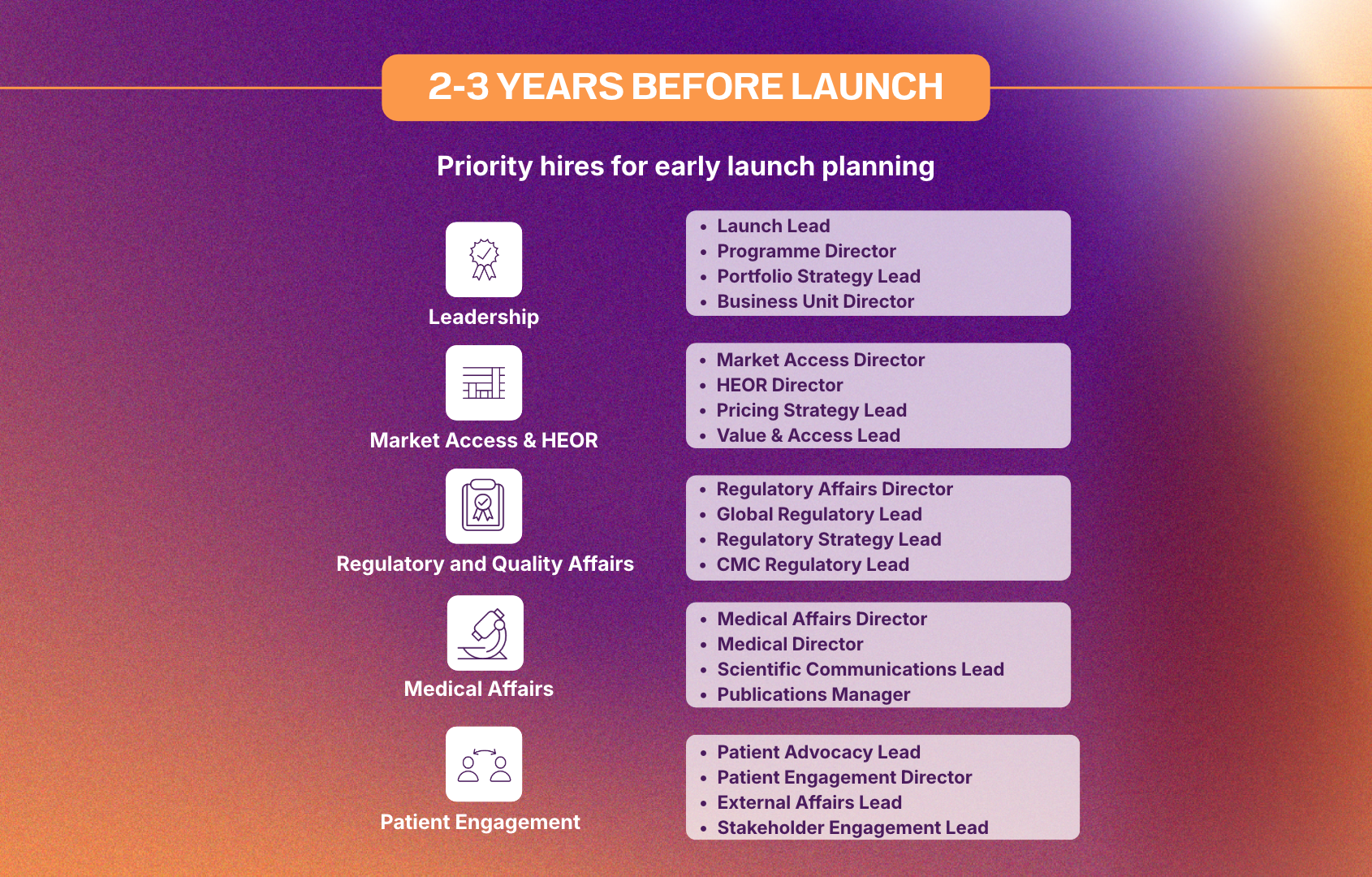
Building a launch team often starts long before regulatory approval. Medical affairs and market access professionals may join early to support evidence generation. They can also start preparing for engagement with stakeholders.
Commercial, regulatory and operational hiring then becomes increasingly important closer to launch.
While exact timelines will vary between products, organisations that align hiring activity with major development and launch milestones are often better positioned to avoid delays and maintain momentum.
If you’re building a life sciences hiring timeline:
| Timing | Key focus | Main hiring areas |
| 2-3 years before launch | Strategy and planning | Leadership, regulatory, medical affairs, market access |
| 18-24 months before launch | Evidence and value demonstration | Medical affairs, HEOR, market access, clinical development |
| 12-18 months before launch | Market preparation | MSLs, marketing, access, analytics |
| 6-12 months before launch | Launch readiness | Sales leadership, training, market access execution, supply chain |
| 0-6 months before launch | Commercial execution | Sales teams, MSL teams, patient services, PV, operations |
| Post launch | Growth and optimisation | Medical affairs expansion, RWE, market access, commercial excellence |


Common hiring mistakes that put pharma product launches at risk
A launch plan can quickly come under pressure when critical roles remain vacant or teams lack the experience they need.
Specialist talent can then become harder to secure when deadlines are tight, particularly when several life sciences companies are recruiting from the same candidate pool. Without dedicated talent acquisition support, hiring may also begin too late.
Here are some of the most common hiring mistakes that can put a launch at risk.
Waiting too long to hire
Leaving recruitment until the eleventh hour can make it difficult to find the right people and give them enough time to prepare. Critical roles may remain vacant, while teams are already working to meet regulatory, commercial or supply milestones. Start planning recruitment against the launch timeline so that essential expertise is in place when the work begins.
Relying on internal mobility
Internal promotions can provide continuity and make good use of existing company knowledge. However, an internal move may not fill every specialist skills gap. Review the capabilities the launch requires and consider external recruitment where the business does not have the right experience in-house.
Underestimating the race for top talent
People with experience of pharmaceutical launches can be in high demand, particularly in specialist or emerging therapeutic areas. A lengthy recruitment process or a delayed offer can mean losing a strong candidate to another employer. Agree the role requirements and decision-making process early, then keep candidates informed as they move through the process.
Only looking at technical skills
Technical and therapeutic expertise are essential but launch roles also involve working across functions and making decisions in a changing environment. Assess candidates’ communication, judgement and ability to collaborate alongside their specialist knowledge. These capabilities can be especially important when teams need to resolve issues quickly.
Building a team without a shared goal
Launch teams bring together people with different responsibilities and measures of success. Without a shared plan, work can be teams may duplicate work while overlooking other tasks.
Set out the launch objectives and assign responsibilities for each decision. Teams should also understand where their work crosses over with other functions so that they can plan around those dependencies.
Failing to plan for post-launch needs
The work does not stop on launch day. As uptake develops, you may need additional support across commercial, medical, market access and supply functions. Consider how the team’s responsibilities and capacity may change after launch and build that into workforce planning. This can help you respond to demand without relying on rushed recruitment.
Building your pharma product launch team
You can have a strong launch strategy on paper, but without the right people to deliver it, things can quickly come unstuck. The key is to build your team in step with the product’s development, bringing in the right expertise as and when it’s needed.
Get ahead of recruitment and you’ll have more time to fill skills gaps, prepare the team and make sure everyone is ready for launch and the busy months that follow.
If you’re planning a pharmaceutical product launch and need help finding specialist talent, speak to our team.
We can discuss the roles you need to fill and help you build a recruitment plan around your launch timeline.

We're partners for progress
Discover how we’ve supported individuals and teams like yours to achieve meaningful growth and accelerate development within the life sciences


